Insertion Sort
Video Lecture
Insertion Operation
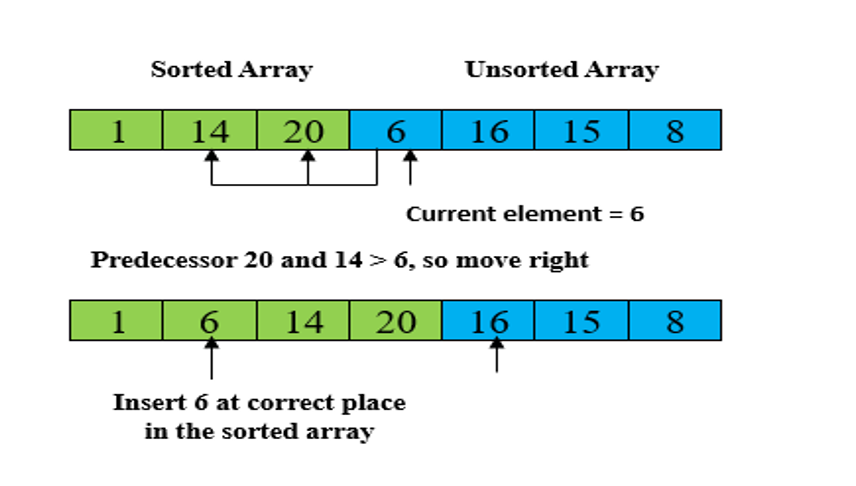
Algorithm
InsertionSort(arr[1]..arr[n])
Input: Array arr contains n elements in unsorted order.
Output: Array arr contains n elements in sorted order.
Step 1: Initially assume arr[1] as sorted array and remaining elements arr[2..n] as unsorted array.
Step 2: Take arr[1] as sorted array.
Step 3: Take value one by one from arr[2] to arr[n] and assign to current value, where i varies from 2 to n.
Step 4: Consider arr[i] as current value & assign current value = arr[i].
Step 5: Compare current value with its predecessor.
Step 6: If the predecessor is greater than the current value, move predecessor to next location in forward direction.
Step 7: If the predecessor is lesser than the current value, insert the current value in the empty location.
Step 8: Repeat steps 3 to 7.
Step 9: Output sorted array.
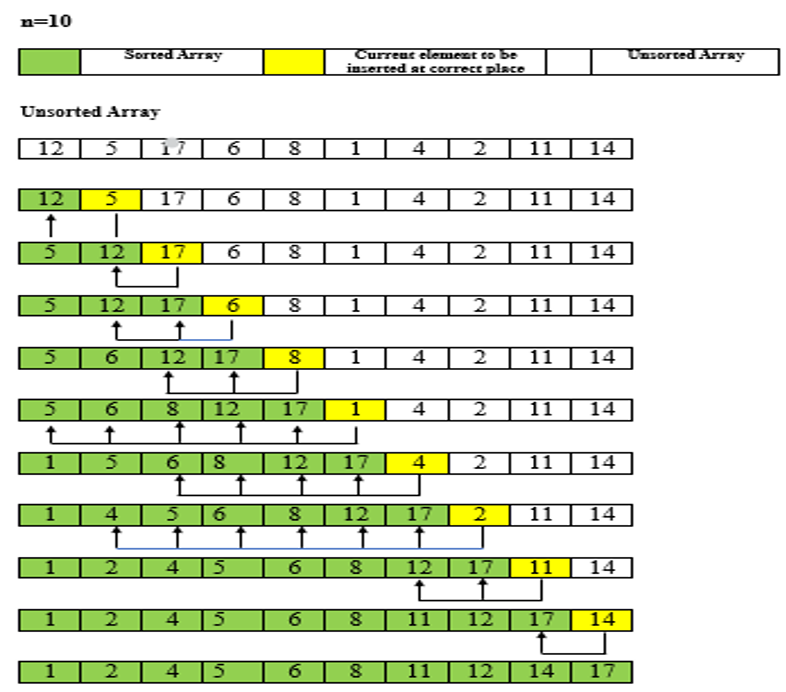
Working of insertion algorithm - Example
Insertion Sort Code
#include <stdio.h>


    /* Function to sort an array using insertion sort */
    void InsertionSort(int arr[], int n) {
        int i, key, j;
        for (i = 1; i < n; i++) {
            key = arr[i];
            j = i - 1;

            // Move elements of arr[0..i-1] that are greater than key
            // to one position ahead of their current position
            while (j >= 0 && arr[j] > key) {
                arr[j + 1] = arr[j];
                j = j - 1;
            }
            arr[j + 1] = key;
        }
    }

    /* Function to print the array */
    void printArray(int arr[], int n) {
        for (int i = 0; i < n; i++)
            printf("%d ", arr[i]);
        printf("\n");
    }

    int main() {
        int n;

        // Get the size of the array from the user
        printf("Enter the number of elements: ");
        scanf("%d", &n);

        // Define the array with a size determined by the user
        int arr[n];

        // Get the elements of the array from the user
        printf("Enter the elements of the array:\n");
        for (int i = 0; i < n; i++) {
            scanf("%d", &arr[i]);
        }

        // Sorting the array using InsertionSort
        InsertionSort(arr, n);

        // Printing the sorted array
        printf("Sorted array: ");
        printArray(arr, n);

        return 0;
    }
#include <iostream>
using namespace std;

void insertionSort(int arr[], int n) {
    for (int i = 1; i < n; i++) {
        int key = arr[i];
        int j = i - 1;

        // Move elements of arr[0..i-1], that are greater than key,
        // to one position ahead of their current position
        while (j >= 0 && arr[j] > key) {
            arr[j + 1] = arr[j];
            j = j - 1;
        }
        arr[j + 1] = key;
    }
}

void printArray(int arr[], int n) {
    for (int i = 0; i < n; i++) {
        cout << arr[i] << " ";
    }
    cout << endl;
}

int main() {
    int arr[] = {12, 11, 13, 5, 6};
    int n = sizeof(arr) / sizeof(arr[0]);

    insertionSort(arr, n);
    printArray(arr, n);

    return 0;
}
public class InsertionSort {

    public static void insertionSort(int[] array) {
        int n = array.length;

        for (int i = 1; i < n; i++) {
            int key = array[i];
            int j = i - 1;

            // Move elements of array[0..i-1], that are greater than key,
            // to one position ahead of their current position
            while (j >= 0 && array[j] > key) {
                array[j + 1] = array[j];
                j = j - 1;
            }
            array[j + 1] = key;
        }
    }

    public static void main(String[] args) {
        int[] array = {12, 11, 13, 5, 6};

        System.out.println("Original array:");
        for (int i : array) {
            System.out.print(i + " ");
        }

        insertionSort(array);

        System.out.println("\n\nSorted array:");
        for (int i : array) {
            System.out.print(i + " ");
        }
    }
}
def insertion_sort(arr):
    for i in range(1, len(arr)):
        key = arr[i]
        j = i - 1

        # Move elements of arr[0..i-1] that are greater than key
        # to one position ahead of their current position
        while j >= 0 and arr[j] > key:
            arr[j + 1] = arr[j]
            j -= 1
        arr[j + 1] = key

def print_array(arr):
    for i in arr:
        print(i, end=" ")
    print()

if __name__ == "__main__":
    arr = [12, 11, 13, 5, 6]
    insertion_sort(arr)
    print("Sorted array:")
    print_array(arr)
Analysis of Insertion Sort
The iterative approach is applied to implement the insertion sort algorithm.
Iterative: The insertion sort algorithm uses a loop to iterate through the array and insert each element into its correct position in the sorted part of the array.
Characteristics of Insertion Sort:
This algorithm is one of the simplest algorithms with a simple implementation.
Time Complexity of Insertion Sort
Complexity Analysis of Insertion Sort: