Bubble Sort
Video Lecture
Bubble Sort Operation
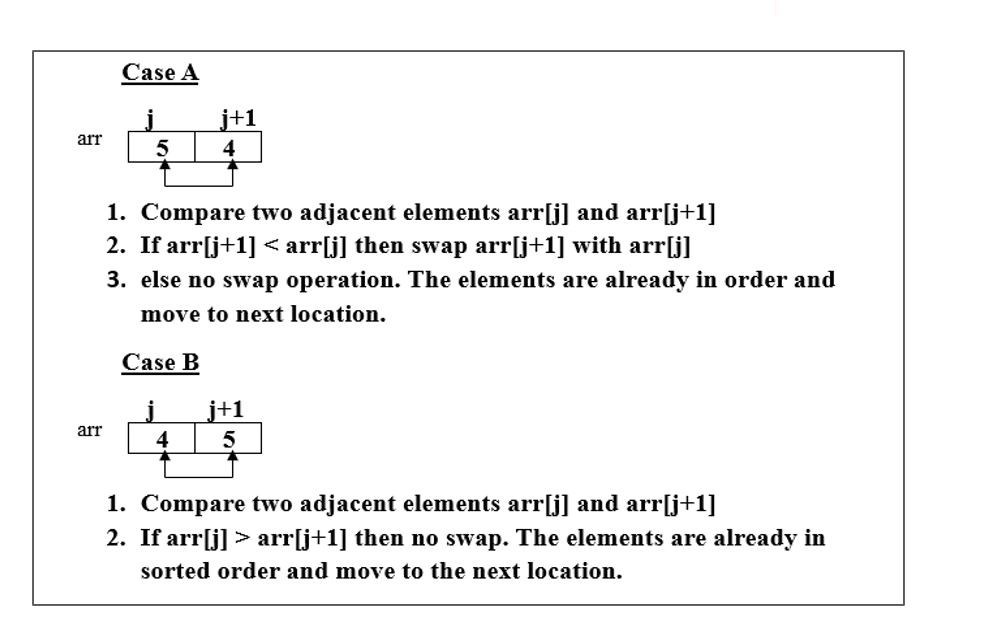
Bubble Sort – Iteration/Passes
Algorithm
BubbleSort(arr[0]..arr[n-1])
Input: Array arr contains n elements in unsorted order.
Output: Array arr contains n elements in sorted order.
Step 1: Initialize i = 0.
Step 2: The for loop variable i varies from 0 to n-2.
Step 3: The for loop variable j varies from 0 to n-2-i.
Step 4: If arr[j] > arr[j+1], then swap arr[j] and arr[j+1].
Step 5: Increment j and go to Step 3.
Step 6: Increment i and go to Step 2.
Step 7: Output the sorted array.
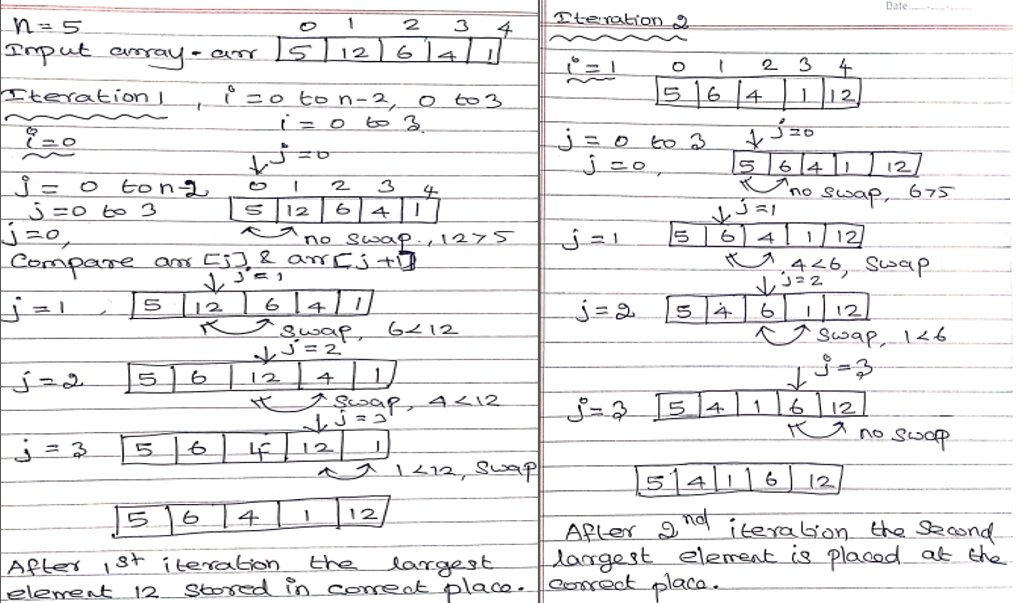
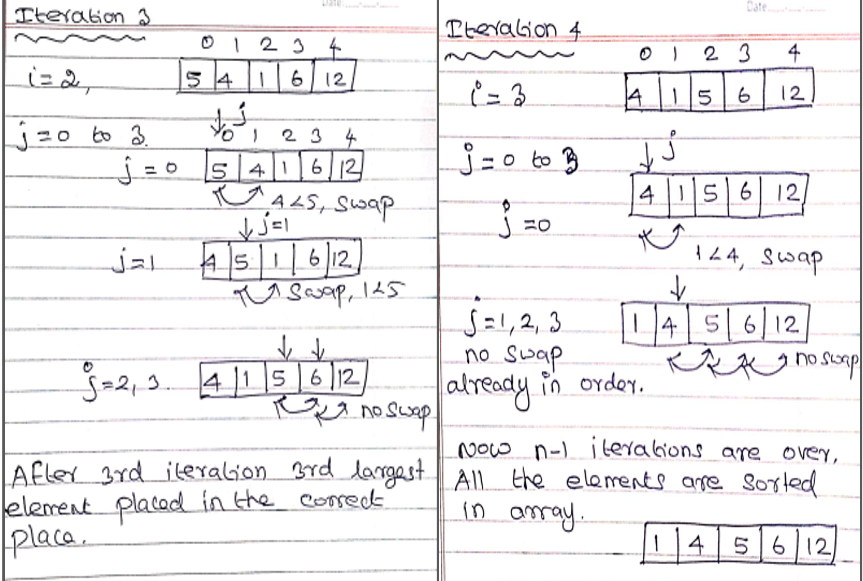
Working of Bubble Sort algorithm - Example
Bubble Sort Code
                        #include <stdio.h>
                        #include

                            // A function to implement Bubble Sort
                            void bubbleSort(int arr[], int n) {
                                int i, j, temp;
                                for (i = 0; i < n - 1; i++) {
                                    // Last i elements are already sorted
                                    for (j = 0; j < n - i - 1; j++) {
                                        // Swap if the element found is greater than the next element
                                        if (arr[j] > arr[j + 1]) {
                                            temp = arr[j];
                                            arr[j] = arr[j + 1];
                                            arr[j + 1] = temp;
                                        }
                                    }
                                }
                            }

                            // Function to print an array
                            void printArray(int arr[], int size) {
                                for (int i = 0; i < size; i++)
                                    printf("%d ", arr[i]);
                                printf("\n");
                            }

                            // Driver code
                            int main() {
                                int n;

                                // Get the size of the array from the user
                                printf("Enter the number of elements: ");
                                scanf("%d", &n);

                                // Declare an array with a size based on user input
                                int arr[n];

                                // Get the elements of the array from the user
                                printf("Enter the elements of the array:\n");
                                for (int i = 0; i < n; i++) {
                                    scanf("%d", &arr[i]);
                                }

                                // Sort the array using Bubble Sort
                                bubbleSort(arr, n);

                                // Print the sorted array
                                printf("Sorted array: ");
                                printArray(arr, n);

                                return 0;
                            }
                        #include <iostream>
                            using namespace std;

                            void bubbleSort(int arr[], int n) {
                                int i, j, temp;
                                for (i = 0; i < n-1; i++) {
                                    for (j = 0; j < n-i-1; j++) {
                                        if (arr[j] > arr[j+1]) {
                                            // Swap arr[j] and arr[j+1]
                                            temp = arr[j];
                                            arr[j] = arr[j+1];
                                            arr[j+1] = temp;
                                        }
                                    }
                                }
                            }

                            void printArray(int arr[], int size) {
                                for (int i = 0; i < size; i++)
                                    cout << arr[i] << " ";
                                cout << endl;
                            }

                            int main() {
                                int arr[] = {64, 34, 25, 12, 22, 11, 90};
                                int n = sizeof(arr)/sizeof(arr[0]);
                                bubbleSort(arr, n);
                                cout << "Sorted array: " << endl;
                                printArray(arr, n);
                                return 0;
                            }
                        public class BubbleSort {

                            static void bubbleSort(int[] arr) {
                                int n = arr.length;
                                int temp;
                                for (int i = 0; i < n-1; i++) {
                                    for (int j = 0; j < n-i-1; j++) {
                                        if (arr[j] > arr[j+1]) {
                                            // Swap arr[j] and arr[j+1]
                                            temp = arr[j];
                                            arr[j] = arr[j+1];
                                            arr[j+1] = temp;
                                        }
                                    }
                                }
                            }

                            static void printArray(int[] arr) {
                                for (int i : arr)
                                    System.out.print(i + " ");
                                System.out.println();
                            }

                            public static void main(String[] args) {
                                int[] arr = {64, 34, 25, 12, 22, 11, 90};
                                bubbleSort(arr);
                                System.out.println("Sorted array:");
                                printArray(arr);
                            }
                        }
                        def bubble_sort(arr):
                        n = len(arr)
                        for i in range(n-1):
                            for j in range(0, n-i-1):
                                if arr[j] > arr[j+1]:
                                    # Swap arr[j] and arr[j+1]
                                    arr[j], arr[j+1] = arr[j+1], arr[j]

                    def print_array(arr):
                        for i in arr:
                            print(i, end=' ')
                        print()

                    if __name__ == "__main__":
                        arr = [64, 34, 25, 12, 22, 11, 90]
                        bubble_sort(arr)
                        print("Sorted array:")
                        print_array(arr)
Analysis of Bubble Sort
Time Complexity
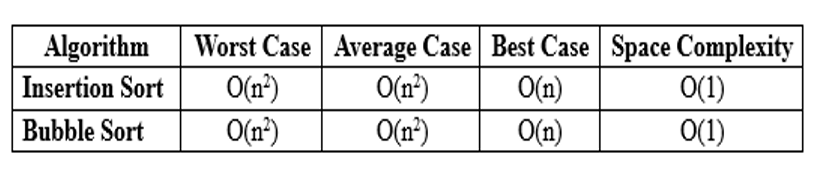
Best Case: In the best case, the input array is already in sorted order, and the algorithm performs a minimum of n-1 comparisons. The best case complexity is O(n).
Worst Case: In the worst case, the input array is in descending order, and the algorithm performs a maximum of n(n-1) comparisons. The algorithm performs n-1 iterations, and each iteration involves a maximum of n-1 comparisons. The worst-case and average-case complexity is O(n²).
Space Complexity
No additional space is required. The space complexity of insertion sort is O(1).
Comparison of Insertion Sort and Bubble Sort